Soul Connection · Epic · Hope
Why can no one simply go home after winning a war?
The weapons are silent, but the war remains inside bodies, families and memory. A map of grief, guilt and repair after victory.
Why the story refuses to end after so much death
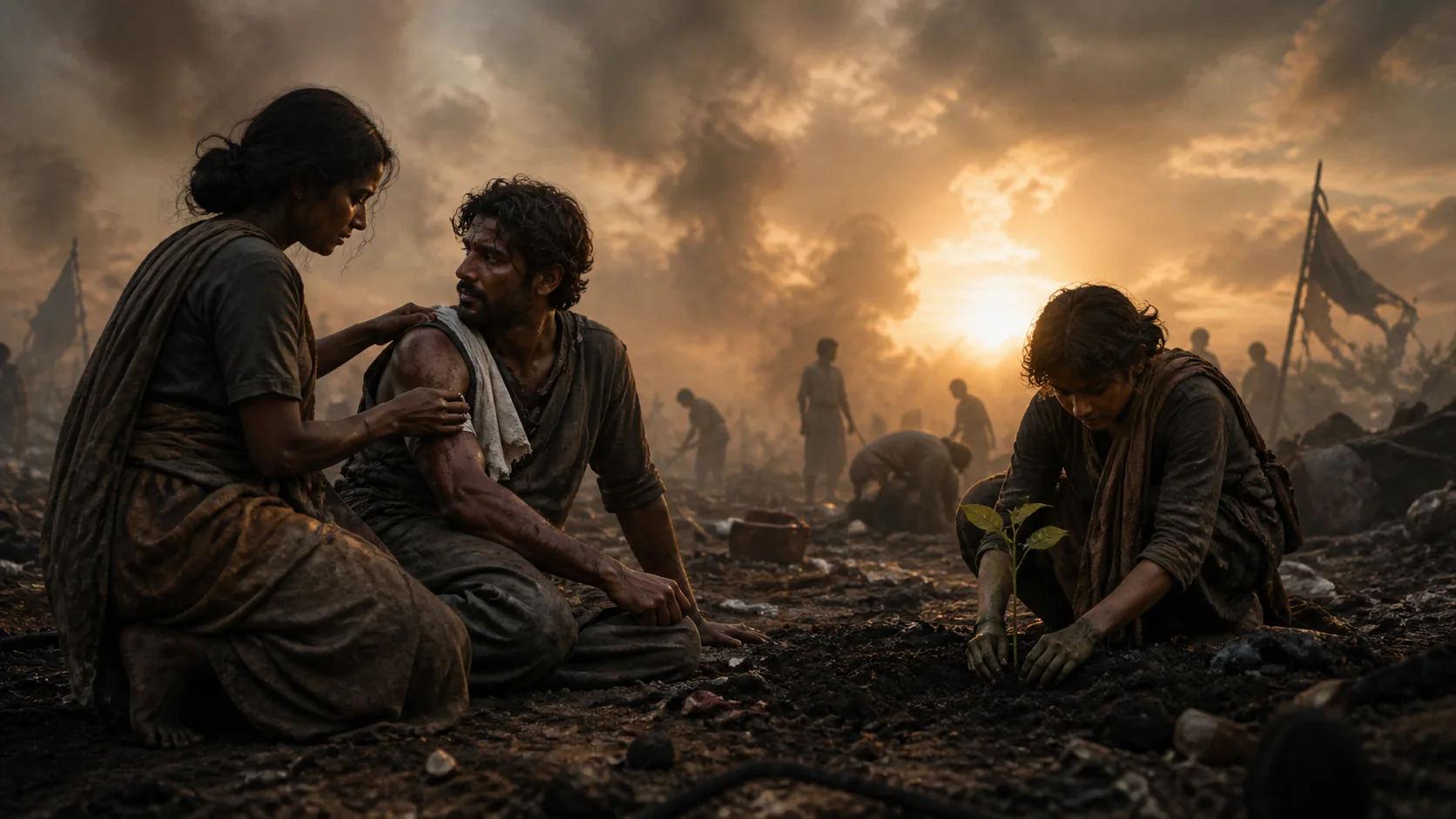
Kurukshetra is quiet after the war, but the quiet is not peace. It is the pause in which weapons have stopped while the war continues inside bodies, homes and memory. Then comes news of another atrocity: Draupadi's sons have been killed in the sleeping camp. The victorious household has no victory scene to inhabit. To reach the recovered throne, the Pandavas must pass the dead bodies of kin, teachers, allies and enemies. In such a landscape the word hope can sound indecent. Asking the bereaved to look ahead too quickly may become another refusal to look at what has been done.
Yet the Mahabharata does not end with the last battlefield triumph. It spends book after book in aftermath. Women identify and lament the dead. Yudhishthira is drawn towards renunciation. The duties and limits of rule require an immense new argument. Dhritarashtra, Gandhari and Kunti later leave the palace for the forest. Long afterwards, the Pandavas relinquish power and walk away. This extended aftermath changes the meaning of hope. Hope is not a mood that replaces grief. It is a discipline of remaining answerable to destruction while choosing actions that do not make revenge the only inheritance available to the future. The narrative also keeps changing the camera position: from ruler to widow, from public victory to a mother naming a concealed son, from a restored dynasty to the companion who can offer nothing in return. Each change interrupts the fantasy that one authorised account can contain the cost of war. Hope needs this wider field of vision because repair begins only when consequence is allowed to speak from more than the victor's position.
Four unfinished tasks of hope after destruction
Make room for the dead, the missing and the living before converting suffering into a lesson.
Victory does not release the winning side from scrutiny of its methods, silences and failures.
Without safety, reparation and institutional change, reconciliation remains a ceremony.
Hope is tested by whether the world becomes more inhabitable for those with the least bargaining power.
Victory without innocence: why grief must alter responsibility
Yudhishthira defeats his political enemies, but victory does not restore innocence. At the end of the Stri Parva, Kunti reveals that Karna was her firstborn. The person fought as a rival is suddenly also the eldest brother. The past cannot be changed, yet its moral meaning is transformed. Decisions were made without complete knowledge; their consequences remain complete. Yudhishthira's anguish can be read as more than personal weakness. It exposes the cost of secrecy, social shame and the stories through which kin were converted into enemies. Accountability may begin here—not by turning oneself into the only monster, but by examining agency, ignorance, method and consequence without self-protective editing.
Guilt, however, is not automatically ethical. It can return a person to those who were harmed, or it can make the guilty person's suffering the centre of the story. If Yudhishthira merely declares himself sinful and leaves for the forest, who governs the widowed, the orphaned, the injured, the emptied fields and the damaged institutions? The debate that follows his wish to renounce therefore raises a question larger than worldly duty. Does remorse remove me from responsibility, or change the way I exercise it? Mature hope chooses the second path. It does not offer self-forgiveness as a shortcut. It makes the person who benefited from victory available for the long, unglamorous labour of repair.
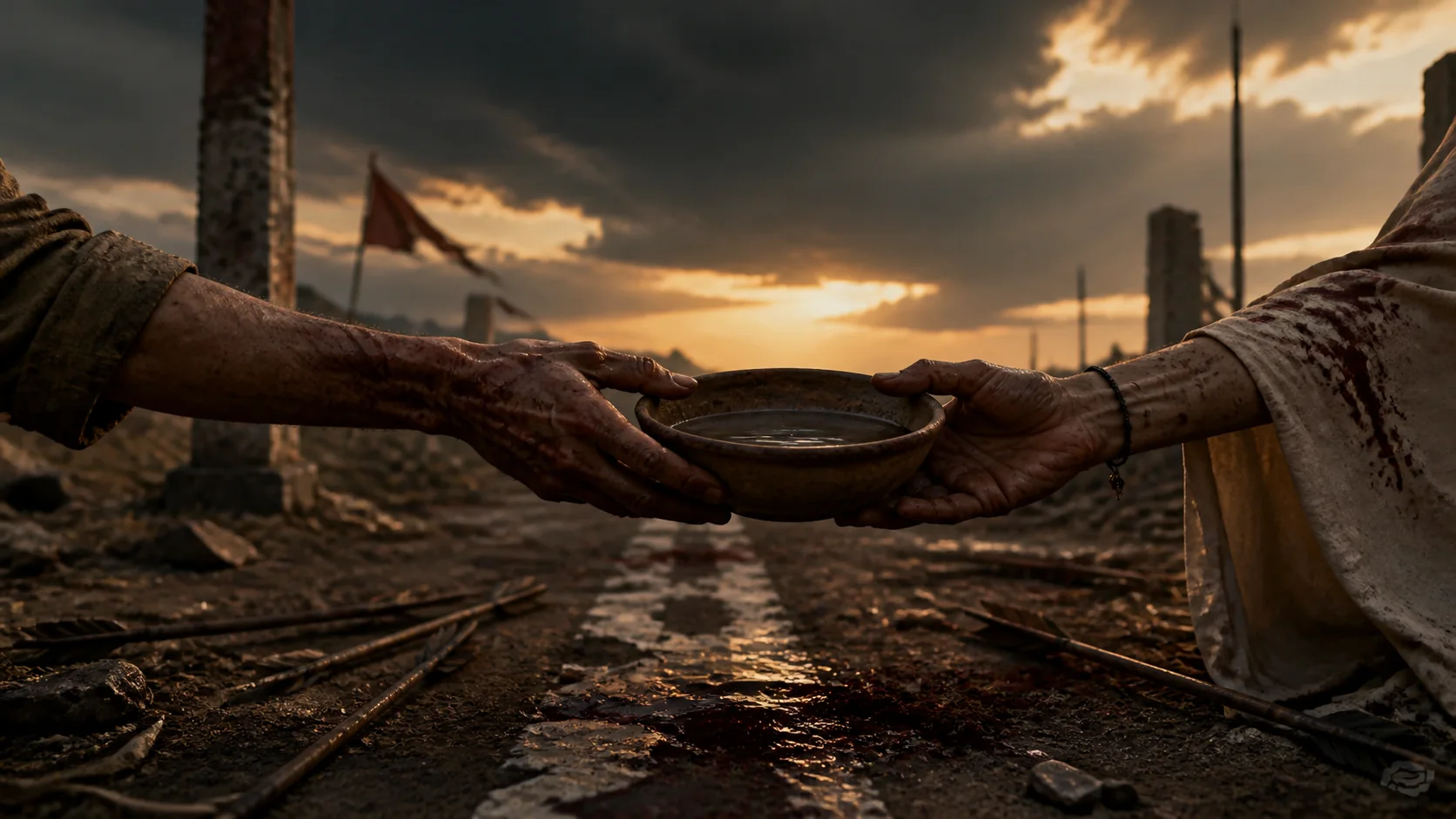
Dharma as scrutiny, not a certificate of redemption
The vastness of the Santi Parva is itself an argument. A battlefield can be organised around a binary—us or them—but a society cannot be governed that way. Rule requires questions about taxation, punishment, advice, protection, famine, corruption and limits on the ruler's appetite. Beside Bhishma's bed, the narrative turns from heroic combat towards institutions and public consequence. Instruction cannot resurrect the dead. What it can do is change the next unit of moral attention: not the warrior's intention alone, but the arrangement of power that will shape the lives of people who did not choose the war.
Returning to the throne is not a certificate of redemption. Competent administration cannot retroactively justify slaughter, and prosperity cannot purchase silence from the bereaved. The restored king is exposed to a continuing test: will every policy reproduce the entitlement for which the war was fought, or will rule become more restrained because the cost is now visible? The epic withholds clean closure. Dhritarashtra and Gandhari's grief remains inside the palace; Kunti eventually accompanies them into the forest; a coronation does not dissolve the losses of the older generation. Hope is not the certainty of forgiveness. It is the attempt to build relationships and institutions in which victims are not required to perform reconciliation.
The necessary objection: whose future is being rebuilt?
A serious objection must be held against this hopeful reading. The epic's reconstruction is largely narrated through royalty, succession and the duties of kings. The wives of ordinary soldiers, the labour required to restore a devastated economy, the political voice of Draupadi and the lives of people outside elite lineages do not receive equal space. The Pandavas recover a kingdom, but what justice reaches those whose bodies made that restoration possible? If the reader focuses only on Yudhishthira's grief and education, the moral journey of a powerful survivor may once again eclipse the powerless dead. Even the explanations given when Draupadi and the brothers fall during the final journey can feel harsh, unequal and deeply patriarchal to a contemporary reader.
The objection does not eliminate hope; it raises its standard. The epic need not be treated as a final constitution. It can remain an ethical laboratory whose silences require questions. Whose testimony is missing? Whose repair is only ritual? Who inherits power, who receives material redress and whose dignity disappears inside the authorised narrative? Contemporary transitional-justice frameworks distinguish but connect truth, justice, reparation, non-recurrence and memory, and they insist that victims participate in processes that concern them. The Mahabharata does not supply that modern framework. Its unfinished grief can nevertheless warn us that a ruler's peace is not social peace, and continuity by itself is not justice.
Hope remains, but it carries the stain of blood
Endurance is an attractive word, but it must be handled with care. When people without power are repeatedly instructed to endure, resilience becomes a language of convenience for those who control the conditions. Draupadi's survival did not make the dice court just. Gandhari's capacity to continue living did not lower the price of the war. Resilience is not a moral debt owed by the survivor. Genuine hope does not build a system on exceptional human strength. It creates support, law, care and public memory so that ordinary people are not required to become heroes every day merely to remain alive.
Dharma is not a fixed answer here. The same person may defend justice in one scene and remain silent in another. A vow may preserve dignity at one moment and destroy relationship at another. The same victory can be liberation for one household and permanent grief for another. Dharma is therefore better read as repeated scrutiny than as a decorative label attached to an outcome. Who paid for my action? Was that cost imposed without consent? What alternatives were available? Can the person I claim to protect speak for herself? Without these questions, dharma becomes the winner's press release. With them, certainty diminishes and responsibility grows.
A new beginning is not an act of forgetting
Hope that says everything will be fine insults reality. Children do not return, betrayal cannot be made not to have happened and some relationships will never stand where they once did. Despair that says nothing can change also removes agency. Between these false certainties lies a grammar of smaller action: tell the truth, preserve names, investigate wrongdoing, offer material reparation, create safety, prevent children from inheriting hatred, and refuse to excuse one's own side by citing the crimes of the other. No single act is reconciliation. Without such acts, however, reconciliation is only a photograph.
A late image in the epic gives this grammar a final test. After years of rule, the Pandavas relinquish everything and walk north. At the end Yudhishthira is accompanied by a dog. Offered heaven on the condition that he abandon the devoted animal, he refuses. The scene need not be accepted as literal theology to possess ethical force. After fame, kingship and civilisational conflict, the test of dharma arrives through the weakest companion, one with no bargaining power. Hope faces the same test. Does it seek only my salvation, my side's triumph and my clean conscience, or does it remain loyal to the vulnerable life that cannot purchase a place in the future?
Specific takeaways
- 01
The end of combat is not the beginning of peace; grief, truth and institutional repair begin when weapons fall silent.
- 02
Turning suffering into a lesson too quickly can reduce both the dead and survivors to instruments of someone else’s moral improvement.
- 03
Yudhishthira's guilt matters only when it changes the practice of responsibility rather than becoming an escape from responsibility.
- 04
Recovering a throne is not redemption; post-war legitimacy is tested by whether power creates restraint, safety and justice.
- 05
The epic's royal focus has limits, and readers must ask after the missing voices of ordinary people, women and powerless victims.
- 06
Resilience is not a moral debt owed by survivors; systems should reduce the need for people to perform heroism simply to live.
- 07
The practical grammar of hope is truth, justice, repair, memory and non-recurrence—not positive feeling.
- 08
The final test of dharma is not the salvation of the powerful, but loyalty to the companion with no bargaining power.
Questions for your own life
- When I ask someone to move on, am I protecting their healing or trying to end my own discomfort?
- Does my guilt return attention to the people harmed, or make me the centre of the story again?
- What evidence of truth, material repair and changed behaviour exists inside the reconciliation I want?
- Does the cost of my decision repeatedly fall on the person with the least power to bargain or refuse?
- Sondesh.tv · Original short essay archive ↗
- Mahabharata, Sauptika Parva, Section 10 · the sleeping camp and the deaths of Draupadi’s sons ↗
- Mahabharata, Stri Parva, Section 14 · Draupadi and Gandhari after the war ↗
- Mahabharata, Stri Parva, Section 26 · Kunti reveals Karna’s birth and Yudhishthira mourns ↗
- Mahabharata, Santi Parva, Section 7 · Yudhishthira proposes renunciation ↗
- Mahabharata, Asramavasika Parva, Section 19 · Dhritarashtra, Gandhari and Kunti in the forest ↗
- Mahabharata, Mahaprasthanika Parva, Section 1 · the Pandavas relinquish rule ↗
- Mahabharata, Mahaprasthanika Parva, Section 3 · Yudhishthira refuses to abandon the dog ↗
- OHCHR · Guidance note on transitional justice: a strategic tool for people, prevention and peace ↗
Arunava Khasnobis
In Soul Connection, Arunava looks at people, art, relationships, failure, moral tension and inner life through conversation. His essays are not episode summaries; they are honest returns to what was heard, tested against his own questions, experience and unfinished understanding.
CONTINUE READING