Soul Connection · Epic · Public life
Why do we search for a Duryodhana in every political conflict?
Calling one leader Duryodhana and another Krishna makes politics easy—and stops civic judgment. When does epic analogy illuminate, and when does it become propaganda?
Why the Mahabharata returns so easily in political news
On a late-night television panel, four people are unable to finish four sentences. A breaking-news ribbon races below them. On social media, a leader appears with Duryodhana's crown while another carries Krishna's discus. The image works instantly. No policy document has to be read, no judicial order opened and no chronology reconstructed. The familiar epic face tells the viewer whom to fear, whom to trust and whose defeat should feel like the victory of dharma. Few devices in political communication are as efficient. The image does more than simplify information. It supplies a complete emotional arrangement: danger, protector, betrayal, destiny and the pleasure of imagining that history has already chosen our side.
Efficiency is also the danger. Once a politician has been cast as Duryodhana, each action arrives already marked as adharma. Once another has been cast as Krishna, every manoeuvre can be excused as strategy in service of a higher good. The citizen no longer investigates; the citizen finds a camp inside a war whose moral ending has already been written. Yet the Mahabharata repeatedly gives us people who defend justice in one scene and fail through fear, loyalty, pride or rigid duty in another. To reduce such a text to a set of party posters is not to bring the epic alive. It is to stop reading it. It also removes the most democratic possibility the text offers: that no inherited title, sacred reputation or past sacrifice can permanently exempt conduct from scrutiny.
Four tests for reading politics through an epic
Which human conflict does the epic scene help us notice in the present?
Dynastic power and constitutional democracy are not interchangeable worlds.
A present-day allegation must be tested through present records, data and reliable sources.
Ask whose right, voice or injury disappears when politics is compressed into analogy.
The dice hall: not one villain, but the failure of an institution
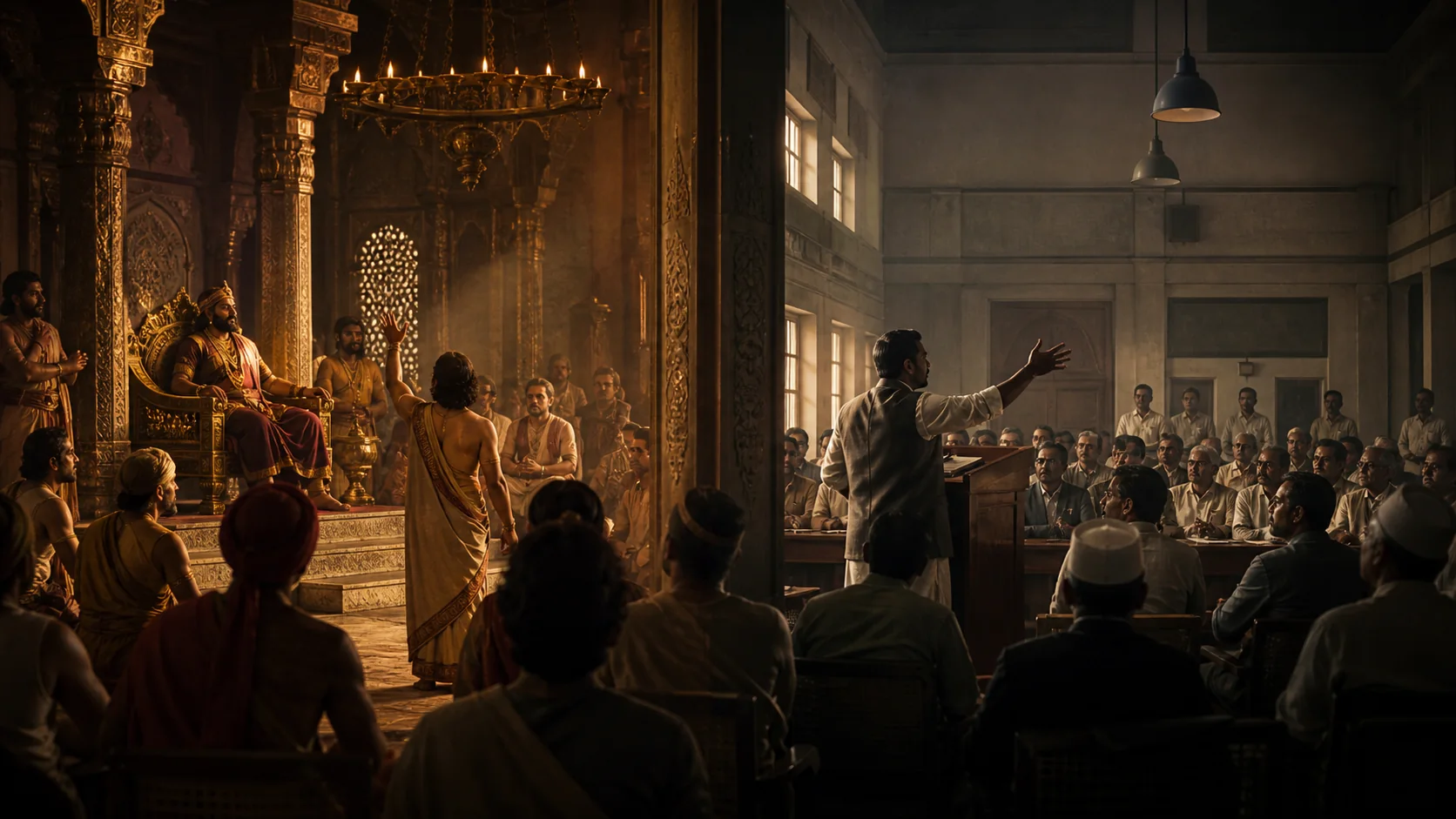
Warnings are present before the disaster in the Sabha Parva. Shakuni proposes exploiting Yudhishthira's weakness. Dhritarashtra says he will consult Vidura, and Vidura warns that gambling breeds conflict. Yudhishthira expresses reluctance, yet places an inflexible vow never to refuse a challenge above his own judgment. The event cannot therefore be contained inside the sentence “Shakuni was evil.” There is a designer, an authorising king, a reluctant messenger, a participant bound by his chosen code and an assembly that does not intervene. Their agency is unequal, but each form of agency must remain visible if responsibility is to be understood rather than dramatised.
Draupadi delivers the scene's sharpest institutional test: if Yudhishthira had already lost himself, what authority remained to stake her? This is not merely a request for personal mercy. It is a challenge to the legitimacy of the transaction. Vikarna attempts an answer and Vidura objects, while most kings remain silent. The building stands, the seats are occupied and procedural language continues, yet the institution has failed. Procedure and justice are not synonyms. The modern lesson is not to identify today's Shakuni. It is to ask which permissions, silences and procedural disguises are allowing harm to proceed even after the warning is known.
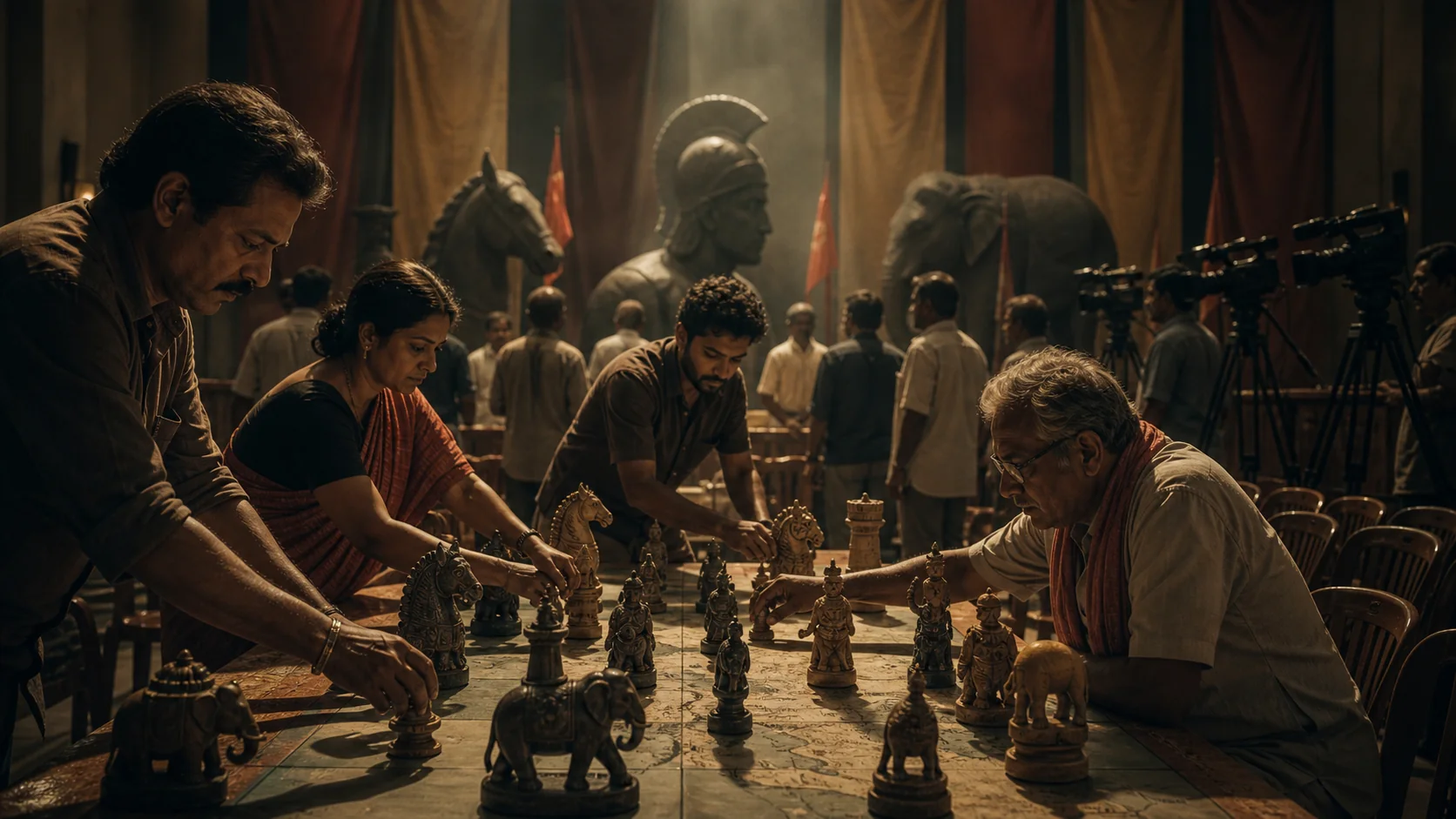
King and citizen: the difference that analogy must preserve
The political world of the Mahabharata is organised largely through dynasty, kinship, territory, warrior obligation and personal counsel. A restrained king may improve security; a partial or weak king can make the system speak his weakness. The Santi Parva contains valuable reflections on self-command, capable advisers and justice that does not distinguish between the ruler's favourites and those he dislikes. But constitutional democracy makes a different promise. Justice is not supposed to arrive as a gift from a virtuous ruler. A right belongs to the person, and institutions are meant to protect it from the ruler's mood.
The Constitution of India places equality before law, freedoms including speech and association, and protection of life and personal liberty inside a written framework. Application may be unequal and institutions may fail, but the citizen's claim is no longer only a plea that the king should listen. Power can be challenged through law, courts, elections, public records and collective action. Calling an elected leader Yudhishthira or Duryodhana can obscure that transformation. An epic king's personal dharma is not the same as a public office's constitutional duty. The modern test is not charisma. It is whether power is limited by rules that apply equally.
The necessary objection: can politics be understood through data alone?
There is a serious objection to an argument that appears to discipline myth too severely. Politics is not only a spreadsheet, statute or institutional diagram. People encounter public life through humiliation, hope, loyalty, fear and belonging. Myth gives those experiences a shared vocabulary. Marginalised communities have also reread inherited stories to recover voices denied by dominant interpretation. Draupadi's question, Ekalavya's wound or Karna's social humiliation can open a door through which people recognise their own experience. To dismiss every epic reference as irrational would surrender a deep layer of public imagination rather than educate it.
The objection is right, but its conclusion cannot be that myth replaces evidence. Story teaches us where to look; it does not write the verdict. Draupadi's humiliation may focus moral attention on gendered power, while the truth of a specific present allegation still requires investigation. Ekalavya may become an image of exclusion, while the fairness of a current policy requires access data, legal standards and testimony from affected people. Emotion ignites the question, evidence directs its heat, and institutions decide whom that heat must not consume. Remove any one of the three and politics becomes either cold technocracy or feverish myth-making.
Where analogy illuminates, and where it hides history
I find it useful to think of analogy as a cinematic cut. Placing the silence of an ancient court beside the silence of a modern institution can create meaning. It helps us recognise a recurring mechanism: advice is suppressed, humiliation becomes public theatre, loyalty imprisons conscience. But juxtaposition does not prove causation. Similar rhythm is not identical history. After an epic scene has raised a question, the answer must return to the present: what does the law say, what does the record establish, who holds authority, which remedy exists and who bears the cost? Without that return, analogy becomes a closed loop in which the story supplies both the accusation and the proof, leaving the person accused no test by which the label can be challenged.
This distinction releases the Mahabharata from the employment of propaganda. A living text can question every new context without becoming a footnote to one manifesto. Its ethical intelligence lies partly in disagreement: Bhishma, Vidura, Draupadi, Vikarna, Karna, Gandhari, Krishna and Yudhishthira do not offer one stable account of duty. Respect for the epic does not mean borrowing its prestige to sanctify our side. It means allowing its most uncomfortable question to turn towards our own loyalties as well as those of our opponents. A reading that only confirms the reader's existing camp has produced recognition without discovery. The greater test is whether the same scene can make our preferred leader, our favourite argument and our own silence newly difficult to defend.
Look past the character and towards the institution
The practical method is demanding but simple. Name the scene that moves you. State the present claim you think it illuminates. Record the differences in law, technology, power and social position. Test the modern claim through official documents, credible reporting, data, judgments or firsthand testimony. Then identify the institution and the human cost: which rule failed, what remedy is possible, and whose life has been reduced to a symbol by your analogy? This does not drain story of feeling. It stops feeling from becoming a cheap weapon against another person. The method should also be symmetrical: if a manoeuvre appears defensible when our side performs it, we must ask whether we would accept the same justification, process and cost when the opposing side holds power.
The Mahabharata is a mirror because it reflects appetite for power, wounded pride, unequal loyalty, courageous dissent, delayed justice and rooms full of respectable silence. It is not a map. The route to a fair budget, a lawful investigation, a protected dissenter or an accountable government cannot be drawn from a list of epic characters. It requires constitutional limits, public reasoning, contemporary knowledge and the participation of people who will live with the decision. The mirror still matters. It must sit at the table of questions, not on the throne of answers. From that position it can deepen democracy rather than replace it, reminding us that political opponents remain citizens and that moral confidence becomes dangerous when it refuses every route of verification.
Specific takeaways
- 01
Epic analogy can reveal a pattern; it cannot establish the cause or truth of a present event.
- 02
The dice hall shows that injustice is often a network of design, permission, rigid duty and institutional silence rather than the work of one villain.
- 03
Draupadi's question tests legitimate authority, not merely mercy; procedure can continue even after justice has failed.
- 04
Ancient reflections on kingship remain valuable, but constitutional rights are citizens' claims rather than gifts from a good ruler.
- 05
Myth can give language to public emotion and marginalised experience, so it must be disciplined by evidence rather than expelled from politics.
- 06
Casting our side as Krishna and the other as Duryodhana becomes moral laundering when identical actions are not subjected to identical tests.
- 07
Modern political claims must return to law, records, data, credible reporting and the testimony of people who bear the consequences.
- 08
The epic belongs at the table of questions, not on the throne from which answers about modern rights and policy are issued.
Questions for your own life
- For the political analogy I am about to share, have I found reliable evidence for its present-day claim outside the epic?
- Do I apply the same moral and constitutional test when my preferred leader and an opposing leader perform similar acts?
- Does the epic label erase the real voice, rights and context of the person to whom I attach it?
- When an institution remains silent after a warning, do I search only for a villain or also trace permission and accountability?
- Sondesh.tv · Original short essay archive ↗
- Mahabharata, Sabha Parva, Section 55 · Shakuni’s proposal and Dhritarashtra’s decision to seek counsel ↗
- Mahabharata, Sabha Parva, Section 57 · Vidura’s warning and Yudhishthira’s vow ↗
- Mahabharata, Sabha Parva, Section 62 · Vidura warns that gambling creates dissension ↗
- Mahabharata, Sabha Parva, Sections 65–67 · Draupadi’s question, Vidura, Vikarna and the silent court ↗
- Mahabharata, Udyoga Parva, Section 31 · the proposal of five villages and peace ↗
- Mahabharata, Santi Parva, Section 93 · restraint, advisers and protection in kingship ↗
- Legislative Department, Government of India · The Constitution of India ↗
- Election Commission of India · Model Code of Conduct ↗

Arunava Khasnobis
In Soul Connection, Arunava looks at people, art, relationships, failure, moral tension and inner life through conversation. His essays are not episode summaries; they are honest returns to what was heard, tested against his own questions, experience and unfinished understanding.
CONTINUE READING