Soul Connection · Epic · Moral conflict
Can the truth still be unjust? Yudhishthira’s most uncomfortable lesson
A sentence can be technically true and still destroy a person. From the dice hall to Drona’s death, what does truth lose without context, power and consequence?
The truth was spoken, yet truth did not survive
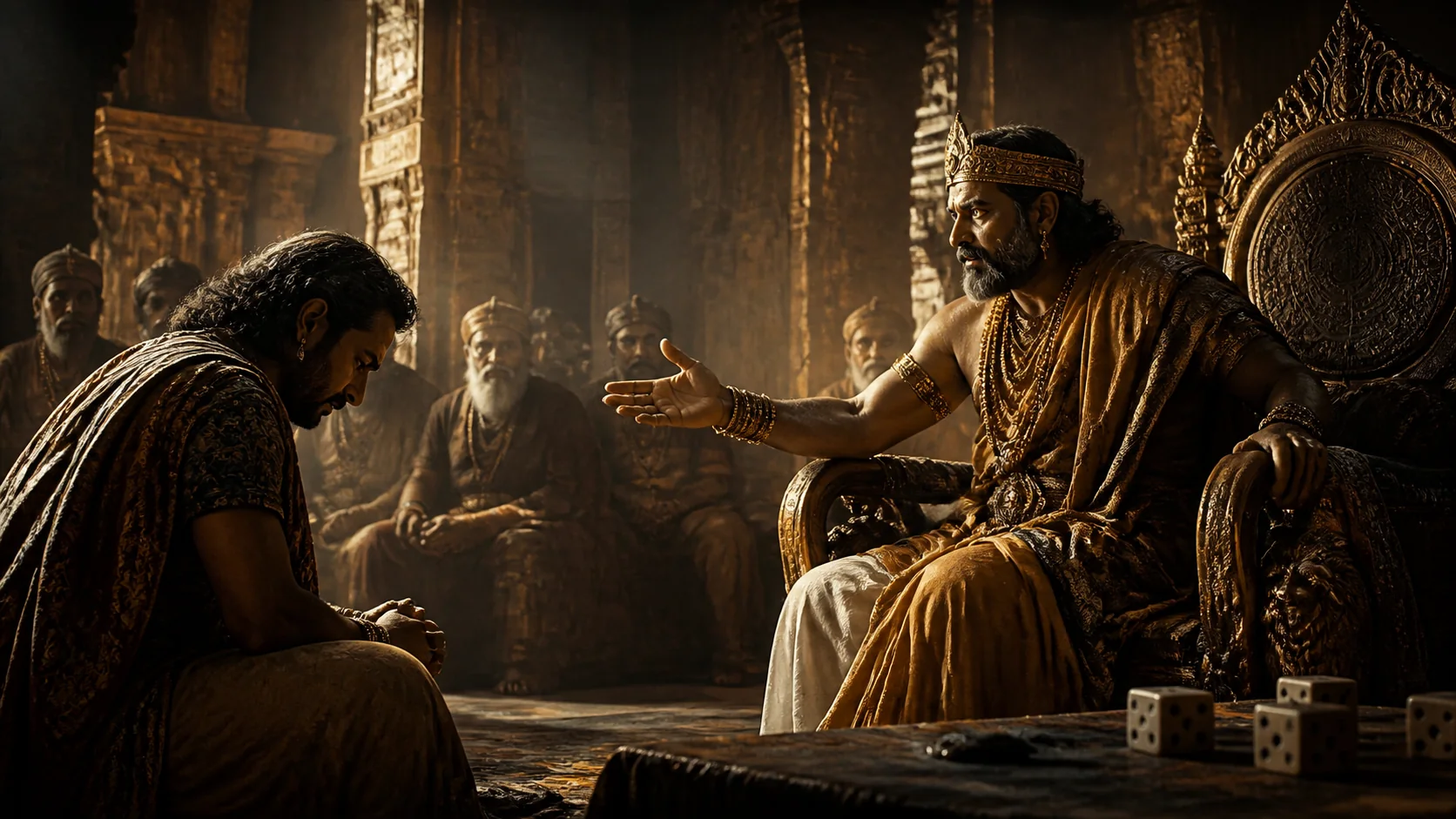
A die comes to rest in the Kuru assembly. Many people in the room already understand that the game is no longer recreation; it has become an instrument of power. The man casting the dice possesses superior skill, the man placing the stakes does not, and the invitation carries the weight of royal authority and public honour. Yudhishthira nevertheless remains seated. He is committed to a code in which a Kshatriya does not refuse a challenge, and to an identity built around obedience to rule. With every throw, however, his kingdom, his brothers, his own freedom and finally Draupadi are drawn into another man’s design. No lie has been spoken by Yudhishthira. Yet the room is filling with injustice.
The shorter version of this essay placed Yudhishthira’s truthfulness inside a familiar binary: greatness or weakness. That frame now seems too narrow. Without principle, Yudhishthira could dissolve into the opportunism surrounding him; the reliability of his word is one of the qualities that separates his moral imagination from Duryodhana’s. Yet when reliability hardens into a fixed self-image, it can replace live judgement. Shakuni exploits more than an appetite for dice. He exploits a moral script whose next line can be predicted. Virtue becomes strategically vulnerable when an opponent knows that the virtuous person will obey the rule even after the rule has ceased to protect its purpose.
Three doors into a truthful statement
Is what has been said factually accurate?
What was omitted, who is listening, and where does power sit?
Is the speaker prepared to answer for the foreseeable meaning and consequence?
The dice hall: following a rule is not the same as protecting justice
In the Sabha Parva, Yudhishthira recognises that the arrangement is unequal. Shakuni is the expert, the stakes belong to another party, and the invitation comes through a family hierarchy capable of converting refusal into dishonour. There is coercion in the room, but coercion does not reduce agency to zero. A fresh decision occurs before each escalating stake. This distinction matters. If Yudhishthira is described only as a helpless victim, his responsibility disappears. If he is described only as a selfish gambler, the architecture designed to capture him disappears. The epic is ethically useful because it allows both truths to remain visible: a person can be accountable for a disastrous decision while the system that made the decision easier, costlier to refuse, and profitable to others is also judged.
Draupadi’s question breaks the legal costume of the game: after losing himself, did Yudhishthira retain the right to stake her? It is more than a technical argument about ownership. She brings the subject of the decision back into a room that has treated her as an object. Her intervention enlarges the meaning of truth. The decision-maker’s internal purity cannot make an action just when the person whose life is being altered has been denied voice and consent. Truth is therefore not a monologue delivered by the most reputable man in the assembly. It must remain answerable to the perspective of the person converted into consequence. Draupadi does not merely ask whether the game followed its rules; she asks whether those rules can recognise a human being.
Ashwatthama: when literal accuracy is designed to deceive
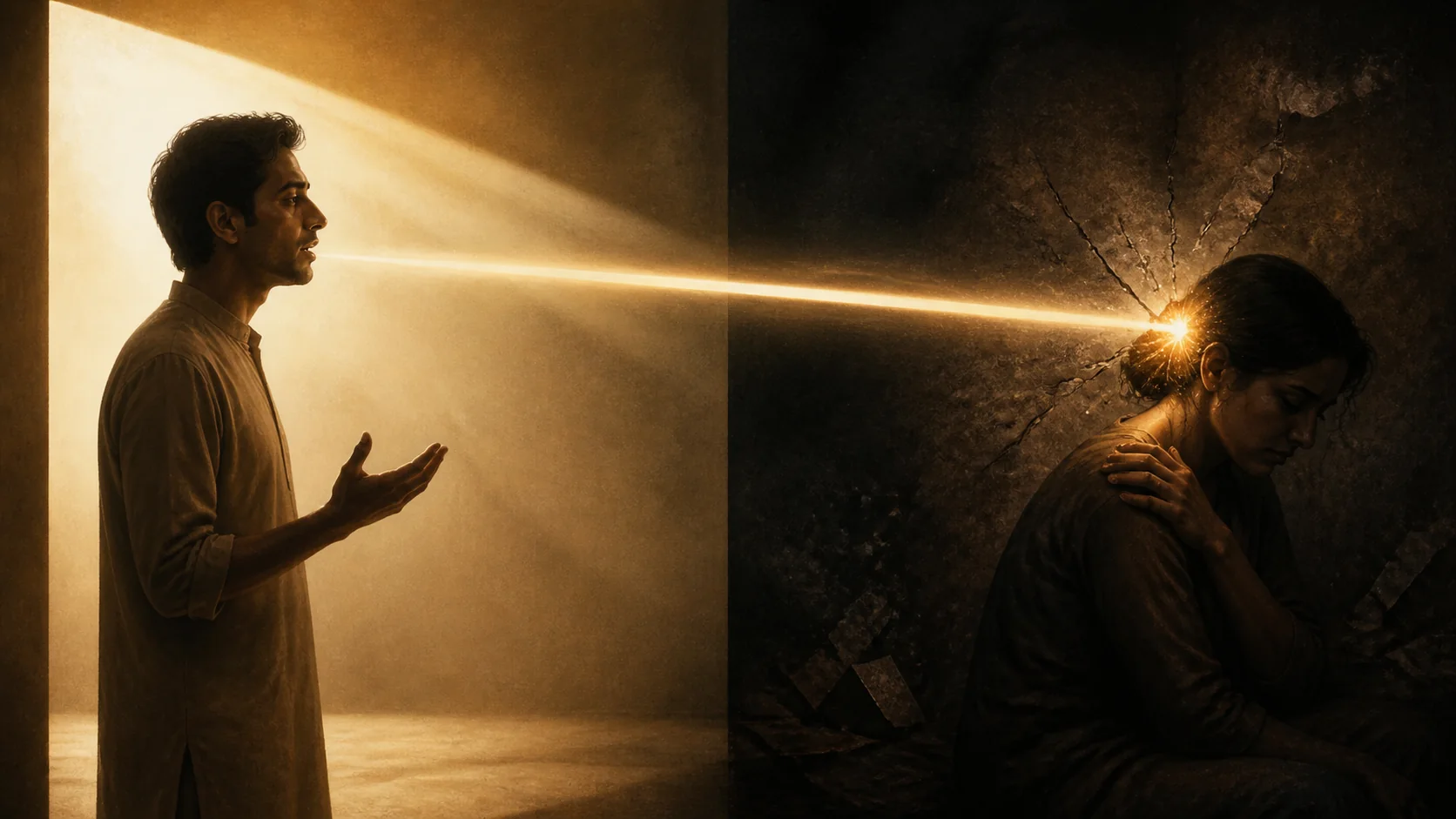
The Drona Parva reverses the problem. Yudhishthira is no longer trapped by strict obedience; he is asked to use language deliberately. Drona’s devastating force cannot be checked while he remains armed, and his trust in Yudhishthira is the Pandava strategy’s most reliable opening. After Bhima kills an elephant named Ashwatthama, Yudhishthira announces the death in a way intended to make Drona believe that his son is gone, while the qualifying word “elephant” is made indistinct. The sentence shelters inside a fact, but the communication aims at a false belief. Literal accuracy cannot make the act innocent when the speaker knows which meaning the listener will take and constructs the sentence to produce precisely that error. Omitted context becomes an action.
The episode cannot be reduced to a comfortable lesson against lying. Drona is inflicting extraordinary destruction; the narrative presents an emergency in which failing to stop him may cost countless more lives. A deception used to end such violence does not carry the same moral weight as a lie told for private gain. Yet emergency does not make the method sacred. Drona’s trust is weaponised, his grief disarms him, and his death follows. Even if the strategic necessity is accepted, moral residue remains: something was saved, something was violated, and victory cannot cancel the second fact. Ethical maturity begins when we refuse both easy absolution and easy equivalence. The cause may be defensible while the means still require grief, explanation and responsibility.
The counterargument: without rules, power will rename convenience as context
A strong objection must be taken seriously. Once context is allowed to qualify truth, almost any manipulation can be defended as necessary. Institutions regularly claim that complete disclosure would cause panic, weaken morale, damage a family or obstruct a larger mission. The people making that argument are often the same people who benefit from secrecy. This is why Yudhishthira’s reputation for truth is not a childish ideal to be discarded. Shared life requires people whose words do not alter with advantage. Evidence, stable rules and a presumption against deception protect the vulnerable precisely because the powerful are unusually skilled at narrating their own exceptions.
The answer is not to replace rules with intuition, but to place exceptions under demanding tests. Is the threatened harm imminent and serious? Was a less deceptive route genuinely unavailable? Does the decision-maker accept any of the cost, or transfer all of it to others? Can the choice be examined later by people who were not invested in its success? The Ashwatthama strategy may satisfy some of these tests and remain troubling under others. That unresolved tension is not a defect in the reading. It prevents moral vocabulary from becoming propaganda. A justifiable emergency choice should still leave a record, a burden and a willingness not to normalise the shortcut after the emergency ends.
The moral loophole inside the righteous king's language
The Mahabharata does not treat dharma as a single instruction manual. The same person meets incompatible obligations under changing conditions. In the dice hall, Yudhishthira continues to act under the cover of formal rule while human responsibility disappears. On the battlefield, he participates in bending language so that Drona will hear the death of his son in the death of an elephant bearing the same name. The two scenes illuminate one another. Literal obedience can lose moral truth; literal accuracy can lose communicative honesty. This is not an argument that everything is relative. It is an argument that truthfulness is more demanding than one clean sentence. Fact, intention, audience, power and foreseeable consequence must remain in the same frame.
There is a danger in every defence of context. A liar can always invent an exceptional circumstance. Governments hide information in the name of security, organisations suppress complaints in the name of reputation, and families restrict autonomy while claiming to know what is best. If an appeal to a larger good is enough to bend truth, the powerful will write the meaning of context. Firm rules, transparent evidence and factual accuracy are therefore essential guardrails. The question is not rule or context. It is who reviews the exception, whether a less deceptive alternative existed, whose life carries the cost, and whether the decision can survive scrutiny after the emergency has passed. Context keeps a rule responsive to life; accountability keeps context from becoming an excuse.
The question that must come before our answer
Contemporary media makes this dilemma ordinary. A number may be correct, a clip may be genuine, and a screenshot may exist, while the omitted before and after reverse the conclusion. We create modern half-truths whenever we share technically defensible fragments designed to produce a misleading meaning. The same pattern appears in institutions: a favourable metric without its denominator, a meeting record without dissent, a performance review built around one incident while a longer pattern disappears. Responsible truth-telling is not a data dump. It makes relevant absence visible and places “what this evidence supports” beside “what it cannot establish.” That modesty may reduce rhetorical force, but it increases the possibility of trust.
Yudhishthira offers no formula that can remove moral risk. He leaves a more difficult discipline. Before a consequential statement, we may need to pause over four questions: what do I know, what remains uncertain, why am I speaking now, and who will carry the result? Such a pause is not cowardice; it is part of the craft of truth. Yet if reflection becomes endless delay in the presence of harm, silence also begins to deceive. We need rules so convenience cannot purchase reality, and judgement so rules do not erase people. Truth, in that sense, is not a spotless identity. It is a relationship among speaker, listener, the absent person, and the future created by the sentence—and a willingness to repair that relationship when our framing has failed.
Specific takeaways
- 01
A factually accurate sentence can still mislead when its framing is designed to produce a false conclusion.
- 02
Rules restrain convenience; context keeps those rules answerable to living people.
- 03
Coercion and agency can coexist: recognising the trap does not erase responsibility, and recognising responsibility does not erase the trap.
- 04
The voice and consent of the person whose life is altered belong inside the ethical test of truth.
- 05
Emergency deception may differ from private lying, but necessity does not erase its moral residue.
- 06
Before sharing a public claim, separate source, date, missing context, verified fact and interpretation.
- 07
Credibility is not a resource to spend for one victory; honest correction and responsibility are how trust is repaired.
Questions for your own life
- Which moral identity expressed as “this is simply who I am” prevents me from hearing changed circumstances?
- When I tell a difficult truth, am I providing the relevant context or using technical accuracy to produce a misleading meaning?
- Does the person who will carry the consequence have a real opportunity to question or refuse the decision?
- After making an emergency exception, what process will review, explain and keep it from becoming normal practice?

Arunava Khasnobis
In Soul Connection, Arunava looks at people, art, relationships, failure, moral tension and inner life through conversation. His essays are not episode summaries; they are honest returns to what was heard, tested against his own questions, experience and unfinished understanding.
CONTINUE READING