Soul Connection · Music · Practice
The world heard mastery. She still heard one wrong note. When is an artist finished?
A practical lens for using dissatisfaction to deepen craft without letting perfectionism consume the artist, drawn from Haimanti Sukla’s life in music.
The flaw only the artist can hear after everyone applauds
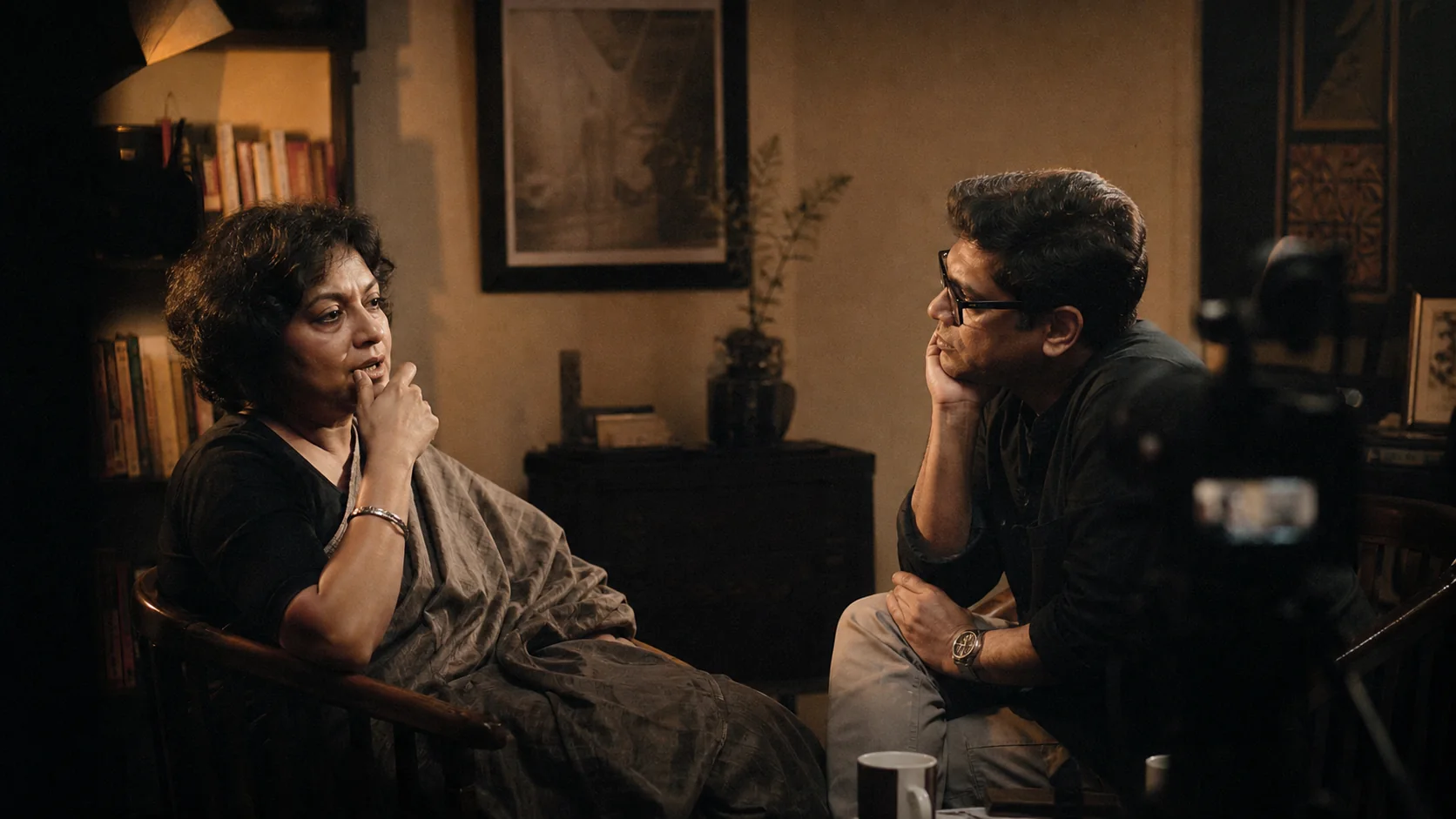
A singer whose songs have lived in Bengali homes for decades says that she has not yet made the note “dha” land in the right place. The statement arrives late in Arunava Khasnobis’s Soul Connection conversation with Haimanti Sukla, after stories of Hemanta Mukhopadhyay, Ravi Shankar, Ali Akbar Khan, Manna Dey, recordings, awards and rooms filled with affection. By every public measure, the career has already supplied its answer. Her own ear has not signed the certificate.
That gap between public evidence and private hearing is the reason to stay with the episode. It would be easy to package her remark as humility from a legend. It is more difficult, and more useful, to ask what such dissatisfaction actually does. Does it keep perception alive, or does it make satisfaction impossible? Does lifelong practice protect the artist from ego, or can it become a respectable name for self-punishment? The conversation does not reduce these questions to advice. It gives us a life in which discipline, opportunity, language, responsibility and pleasure repeatedly meet inside the act of singing.
Three moves from dissatisfaction to practice
Replace “I am not good enough” with the exact note, breath, phrase or feeling that needs attention.
Place the problem inside the complete emotional journey rather than repairing one isolated line.
Turn discomfort into one small repeatable task for the next private session.
Her father withheld praise, but carried the record in his pocket
Haimanti’s memory of early training contains both discipline and affection. Her father, Pandit Harihar Sukla, would light a candle and make the duration of its flame the duration of practice. When the very young child mispronounced words in a bhajan and received a rare physical correction, he later returned with sweets to repair the hurt. These details belong together. Remove the tenderness and rigor becomes cruelty; remove the demand and love becomes a story with no account of how skill was formed.
Years later, even after her records became known, her father did not tell her that the singing was complete. She recalls that a Ravi Shankar record stayed in his pocket, a quiet sign of pride, while his spoken assessment remained unsatisfied. In maturity she can hear limitations in recordings that once felt different to her. It is tempting to turn this into a rule that praise weakens artists. That would be careless. A child deprived of secure approval may learn fear more efficiently than craft.
The useful distinction is between the person and the work. “You matter to me” is a statement about relationship. “This phrase has not opened yet” is information about craft. Without the first, correction can become a threat to belonging. Without the second, affection may prevent growth. Teachers, parents, editors and directors do not need to imitate the severity of another age. They need language exact enough to challenge the work without making human worth the object under examination.

Classical training did not make her sing one way; it taught her how to change
A striking thread in the conversation is Haimanti’s refusal to treat classical training as a single audible style. She had passed auditions in khayal and thumri, yet deliberately entered Bengali modern song and lighter forms. When the material was playful, she did not burden it with ornaments simply to display what she knew. Her account of changing herself for each composition suggests a deeper definition of technique. Mastery is not the need to show the entire vocabulary. It is the freedom to choose only what the song requires.
That freedom carried a linguistic commitment. Haimanti speaks of a profound attachment to Bengali despite family roots in Uttar Pradesh. She did not express that love only as identity. She asked musicians of extraordinary stature to imagine Bengali songs with her. When Ravi Shankar first resisted because composing in a language and setting he did not regularly inhabit would take time, she returned with Bengali words placed on one of his known melodies and sang two lines. The demonstration changed the conversation and led to new work. She made related approaches to Ali Akbar Khan and Naushad.
These stories are often enjoyable as evidence of access to famous people, but their practical meaning is larger. Practice also prepares an artist to make a precise proposal. Affection for a language becomes consequential when the singer can demonstrate how it might live inside a composer’s musical world. Adaptability then is not submission to the market. It is a trained body meeting the specific body of a new song, while a cultural conviction decides which doors are worth opening.
Can a perfect line still fail the complete song?
Haimanti’s clearest criticism of contemporary recording concerns fragmentation. Earlier sessions often required musicians and singer to travel through the whole song together. Current production can repair a weak line, adjust pitch or assemble a performance from separate takes. Her question is emotional rather than technical: if the singer has not carried the full sentence, how will the later line contain what the earlier words have done? A phrase of separation has meaning because desire and delay have already accumulated before it.
Nostalgia is not a sufficient answer. A live take can be emotionally empty, and editing can enable subtle choices, accessible production and collaborations that older systems made impossible. The tool is not the problem. The risk is that the possibility of repair removes the necessity of comprehension. When a performer perfects only the fragment under inspection, the technical note can be correct while the thought of the song vanishes.
The same pressure now shapes writing, acting and public conversation. We polish the paragraph without testing the argument, rehearse the close-up without carrying the scene, and circulate the clip after forgetting the conversation around it. Haimanti’s concern is therefore not a museum defence of old equipment. It is a discipline of wholeness. Use the patch, but arrive at the patch after the complete work has passed through the mind and body.
A candle, a complete song and the changing shape of practice
Haimanti describes training that began before she was old enough to make a career plan. Her father, Pandit Harihar Sukla, would light a candle and ask her to continue singing until it went out. The image is simple, but the lesson is not merely endurance. A child learns that time with the note is ordinary, not an emergency performed before an examination. She also recalls that her father rarely praised her singing, even when records composed by Ravi Shankar gave him visible pride. Years later, she can hear the shortcomings in those early recordings that she could not recognise then. The standard was inherited, but her present ear has made it her own.
The episode also resists a romantic picture of one pure classical path. Haimanti realised early that recognition through classical music alone would be difficult, and she wanted to sing in several forms. She tells Arunava that the singer must change herself according to the song. Classical grounding did not require every Bengali modern song to display classical ornament. Its deeper use was control: knowing the note well enough to choose what the composition needed, and knowing when virtuosity would be an intrusion. Practice therefore appears not as the repetition of a single identity, but as the preparation to become specific each time.
Turning the unfinished note into an address, not a punishment
That distinction matters in a production culture built around fragments. Haimanti contrasts the older practice of learning and recording a complete song with sessions in which a line can be patched separately. Editing is not automatically the enemy of feeling, and older methods were not automatically superior. Technology can protect a performance, lower cost and make experimentation possible. The danger begins when repair removes the need to understand the whole. If a singer only perfects the visible fragment, the words before it and the emotional consequence after it stop exerting pressure. Technical accuracy may remain while the song’s thought disappears.
The unfinished “dha” is valuable only if it leads back to listening. It should not become a verdict that erases a career, a body or a day’s honest work. Haimanti’s life offers a more exact arrangement: affection may be received, achievement may be acknowledged, and the ear may still ask for another attempt. Completion is not the moment when the artist can no longer hear a flaw. It may be the ability to hear one without turning the whole self into a flaw.
Specific takeaways
- 01
Replace “I am not enough” with the exact note, breath, word, rhythm or emotion that needs work.
- 02
Receive praise and correction as two different kinds of information; neither has to cancel the other.
- 03
Perform or review the complete work at least once before repairing an isolated fragment.
- 04
End each practice session with one small repeatable task for the following day.
- 05
Record the work and listen after some distance; the memory of performing is not the same as the sound produced.
- 06
Protect a private practice room where mistakes do not have to become content or explanation.
- 07
When teaching or directing, preserve the person’s dignity while naming the weakness in the work precisely.
- 08
If dissatisfaction damages sleep, health, release or joy, treat it as a signal for support rather than evidence of high standards.
Questions for your own life
- The last time you called your work bad, could you name the exact weakness?
- Which part of your practice still happens without an audience or a camera?
- Where is technology helping your work, and where is it allowing you to avoid understanding the whole?
- Does your inner critic identify a next action, or does it only attack your identity?
- What unfinished note can you approach tomorrow with one small, specific task?
The world heard mastery. She still heard one wrong note. When is an artist finished?
Watch the complete episode ↗
Arunava Khasnobis
In Soul Connection, Arunava looks at people, art, relationships, failure, moral tension and inner life through conversation. His essays are not episode summaries; they are honest returns to what was heard, tested against his own questions, experience and unfinished understanding.
CONTINUE READING